
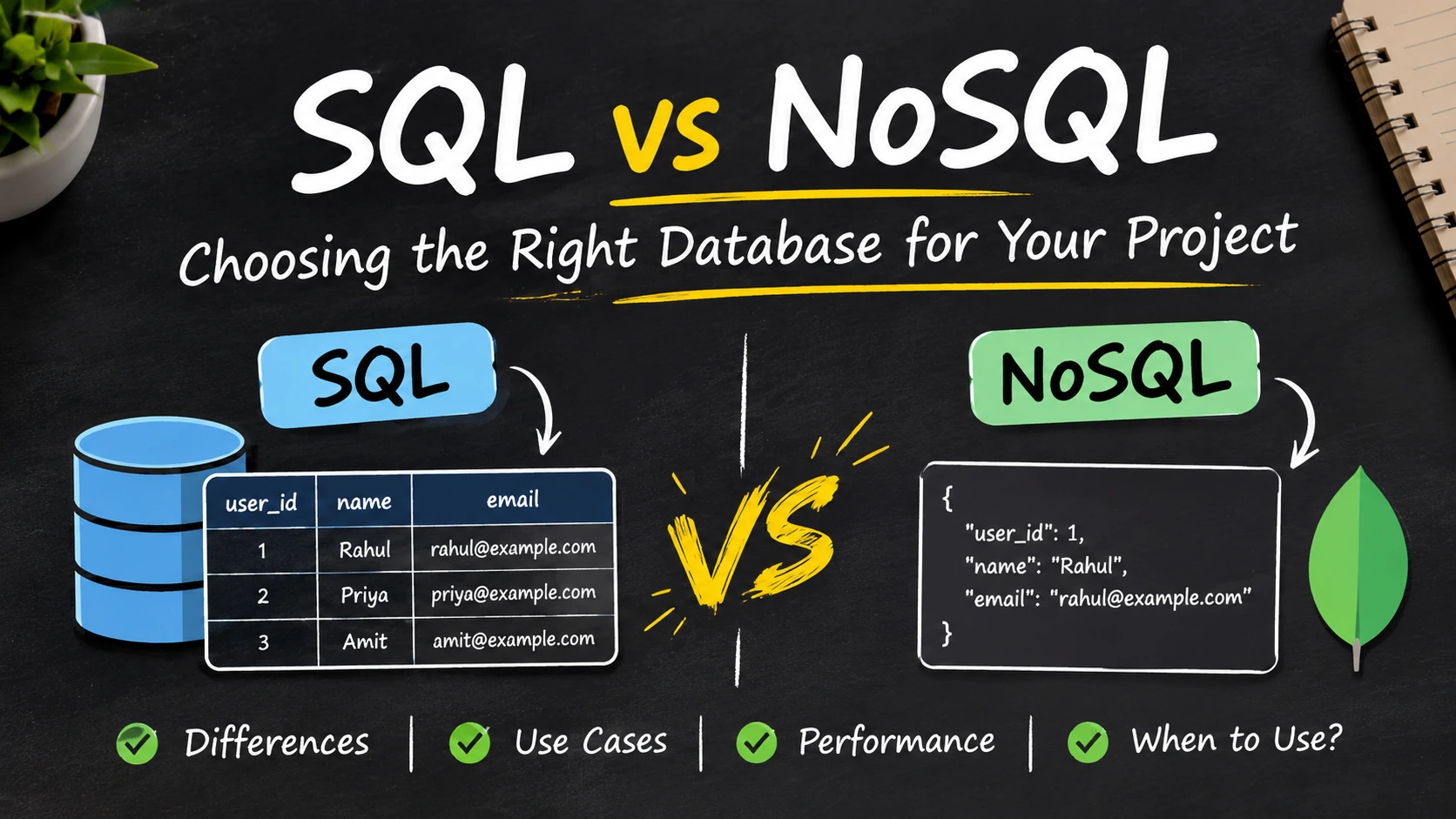
SQL vs NoSQL: Choosing the Right Database for Your Project
Confused between SQL and NoSQL? Explore their differences, performance, scalability, database types, real-world applications, and practical examples to choose the right database for your next software project.

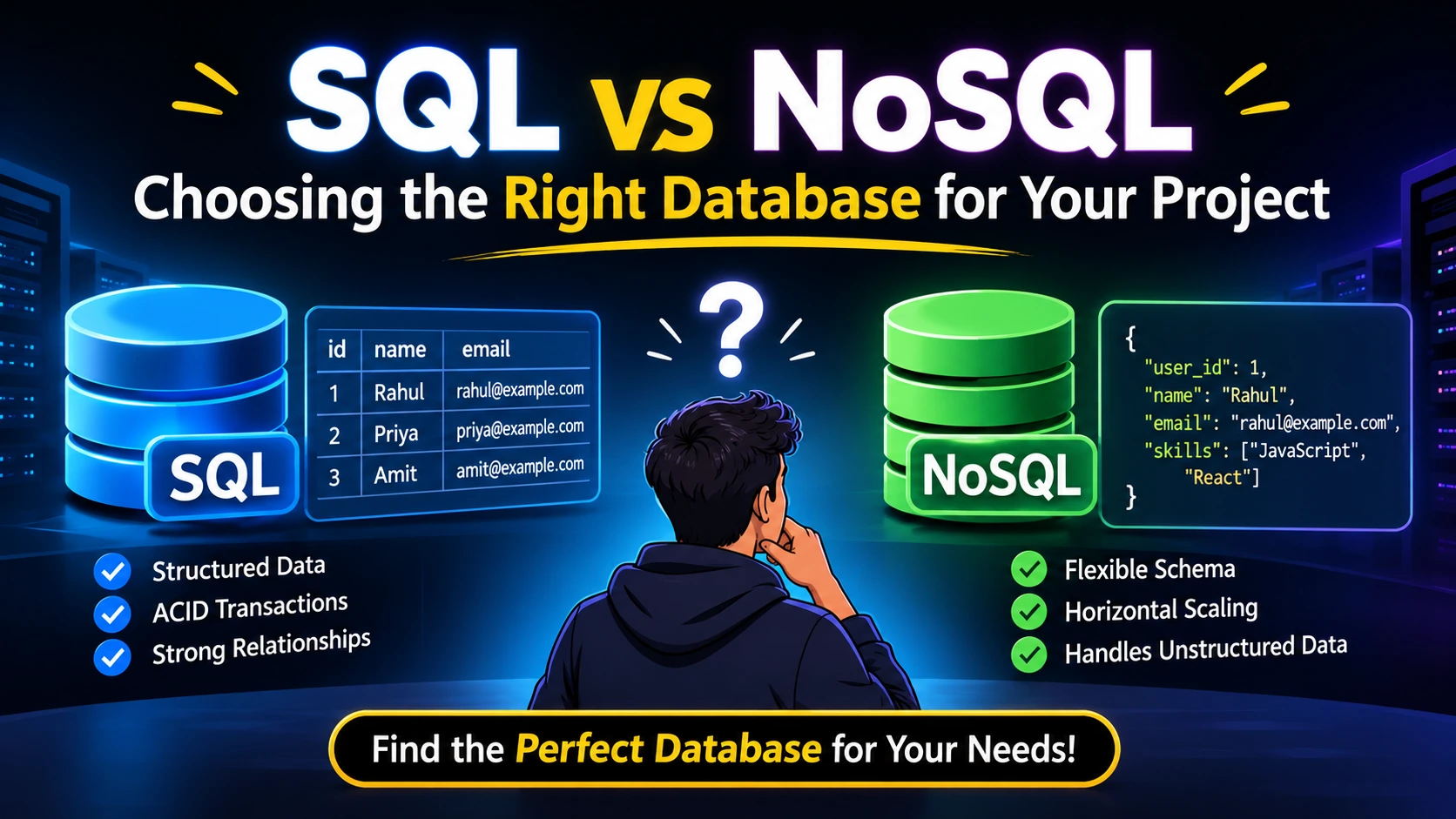
Table of Content
Table of Content
Choosing the right database is one of the most important decisions when building a software application. Whether you are developing a business website, an e-commerce platform, a mobile application, a SaaS product, or an enterprise-level system, your database plays a major role in how your application stores, manages, retrieves, and protects information.
Many developers face the same question when starting a new project: Should I use SQL or NoSQL?
Both database technologies are widely used in modern software development. SQL databases have been around for decades and are known for structured data management, relational models, and reliable transactions. NoSQL databases, on the other hand, offer flexible data models and are often preferred for applications that handle rapidly changing data structures, distributed workloads, or large volumes of unstructured information.
However, choosing between SQL and NoSQL is not simply about deciding which technology is faster or more popular. The right choice depends on your application's requirements, data relationships, scalability expectations, consistency needs, development workflow, and long-term maintenance.
For example, a banking application requires reliable financial transactions and strict data consistency. An application that manages millions of user-generated documents may benefit from a flexible document database. Similarly, an e-commerce platform might need relational storage for orders and payments while using a different database for product search or caching.
In this guide, we will explore SQL and NoSQL databases in detail, understand their differences, examine practical use cases, and discuss how to select the right database architecture for your project.
1. What Is a SQL Database?
SQL stands for Structured Query Language. It is the standard language used to communicate with relational database management systems.
A SQL database stores information in structured tables consisting of rows and columns. Each table represents a particular type of information, while relationships between tables help organize connected data.
For example, consider an online shopping application. It may have separate tables for:
- Users
- Products
- Orders
- Payments
- Shipping addresses
- Order items
Instead of storing everything in one large table, a relational database organizes information into smaller, connected tables.
Each table generally has a primary key that uniquely identifies a record. Foreign keys establish relationships between records in different tables.
Example of a relational database
Imagine an application with two tables: Users and Orders.
Users Table && Orders Table
Notice that the user information is stored separately from the order information.
The user_id column in the Orders table connects each order to its corresponding user.
This structure avoids unnecessary duplication and makes it easier to manage related information.
How SQL databases work
When an application needs information from a database, it sends an SQL query.
For example:
SELECT name, email
FROM Users
WHERE user_id = 1;
This query retrieves the name and email address of the user whose ID is 1.
SQL databases also support advanced operations such as:
- JOIN operations between multiple tables.
- Aggregation using COUNT, SUM, AVG, and other functions.
- Filtering and sorting records.
- Transactions involving multiple database operations.
- Constraints to maintain data integrity.
- Indexing to improve query performance.
These capabilities make relational databases particularly useful when an application depends on well-defined data relationships.
Popular SQL databases
Some widely used relational database management systems include:
1. MySQL
MySQL is one of the most popular relational databases used in web development. It is commonly used with PHP, Node.js, Python, Java, and other backend technologies.
It is suitable for business applications, content management systems, e-commerce platforms, and SaaS products.
2. PostgreSQL
PostgreSQL is an advanced open-source relational database known for its standards compliance, extensibility, powerful querying capabilities, and support for complex data types.
It is frequently used in financial systems, enterprise applications, analytics platforms, and large-scale backend services.
3. Microsoft SQL Server
Microsoft SQL Server is a relational database management system widely used in enterprise environments.
It provides database management, reporting, security, analytics, and integration capabilities that are useful for business-critical applications.
4. Oracle Database
Oracle Database is an enterprise-grade relational database designed for demanding workloads, large organizations, and complex business environments.
It is commonly used in banking, telecommunications, enterprise resource planning, and other industries where database reliability is important.
2. What Is a NoSQL Database?
NoSQL stands for Not Only SQL. It refers to a category of databases that use data models other than the traditional relational table structure.
Unlike SQL databases, NoSQL databases do not require every record to follow the same table-based structure. Depending on the database type, information can be stored as documents, key-value pairs, graphs, or wide-column records.
This flexibility can be valuable when an application handles data that changes frequently or does not naturally fit into relational tables.
For example, imagine developing a social media application.
A user profile might contain:
- Name
- Profile picture
- Biography
- Interests
- Social links
- Account preferences
Another user might have additional fields, such as professional details, location preferences, or verification information.
A document-oriented database can store these records with different structures without requiring every optional field to be defined as a column in advance.
Example of a NoSQL document
A MongoDB document might look like this:
{
"_id": "user_101",
"name": "Rahul Sharma",
"email": "rahul@example.com",
"profile": {
"age": 25,
"city": "Pune"
},
"skills": [
"JavaScript",
"React",
"Node.js"
],
"isActive": true
}
This information is stored as a document rather than as a traditional relational row.
The application can also store nested objects and arrays directly inside the document.
How NoSQL databases work
NoSQL databases use different storage and query mechanisms depending on their data models.
For example, a document database stores records as documents, while a key-value database retrieves values using unique keys.
Some NoSQL databases are designed for distributed storage, allowing data to be replicated or partitioned across multiple servers.
Their architecture can help applications handle workloads involving large numbers of records, frequent writes, distributed access, or changing data structures.
However, NoSQL does not automatically mean faster performance or unlimited scalability. Actual performance depends on the database engine, indexing strategy, hardware, query patterns, and system architecture.
Main types of NoSQL databases
NoSQL databases are generally divided into four major categories.
1. Document Databases
Document databases store information in document-based formats such as JSON or BSON.
Each document can contain fields, arrays, and nested objects.
Popular examples include:
- MongoDB
- Couchbase
- Amazon DocumentDB
Document databases are useful for applications involving user profiles, product catalogs, content management, and applications with evolving data structures.
2. Key-Value Databases
Key-value databases store information using a unique key and its associated value.
For example:
user:101 = Rahul Sharma
session:abc123 = active
cart:101 = product_data
Applications retrieve information by providing the corresponding key.
Popular examples include:
- Redis
- Amazon DynamoDB
- Riak
Key-value databases are frequently used for caching, session management, real-time counters, and fast lookups.
3. Wide-Column Databases
Wide-column databases organize information into rows and column families rather than relying on a traditional fixed relational table structure.
They are designed for distributed data storage and workloads involving large datasets.
Popular examples include:
- Apache Cassandra
- Apache HBase
- Google Cloud Bigtable
These databases can be useful for event processing, large-scale logging systems, time-series workloads, and applications that need distributed write capacity.
4. Graph Databases
Graph databases represent information using nodes, relationships, and properties.
Instead of focusing primarily on tables or documents, they are designed to make connected data easier to explore.
For example, a social networking platform might represent:
- People as nodes.
- Friendships as relationships.
- Interests as properties.
- Groups as connected entities.
Popular examples include:
- Neo4j
- Amazon Neptune
- ArangoDB
Graph databases are particularly useful for recommendation engines, fraud detection, network analysis, and social relationship management.
3. SQL vs NoSQL: Key Differences
Although both database categories solve the problem of storing and retrieving information, they differ in their data models, consistency approaches, querying methods, and typical architectural patterns.
Understanding these differences will help developers make better decisions.
Data Structure
SQL databases organize information into tables with predefined columns and data types.
This structure is useful when records follow a consistent format and relationships between different entities are important.
NoSQL databases support multiple data models, including documents, key-value pairs, wide-column records, and graphs.
They are useful when data structures vary or when the application's information naturally fits one of these models.
Schema Flexibility
Traditional relational databases generally use predefined schemas.
For example, if a Users table contains name, email, and phone columns, adding a new field normally requires a schema migration.
Modern relational databases also support JSON and other flexible data types, so the distinction is not absolute.
Document databases typically allow documents within a collection to have different fields.
This can simplify development when application requirements change frequently, although maintaining consistent document structures is still important.
Relationships Between Data
SQL databases are designed to manage relationships between records.
JOIN operations allow developers to retrieve related information from multiple tables.
For example, an e-commerce application can retrieve customer information, orders, and payment records through relational queries.
In NoSQL databases, related information is often embedded within documents or connected through references.
Embedding can improve read efficiency when related information is usually accessed together. However, it can introduce duplication and update complexity.
Orders Table
SQL databases use SQL as their primary query language.
Developers can perform complex queries involving filtering, joins, grouping, sorting, and aggregation.
NoSQL databases use different query mechanisms depending on the database engine.
For example, MongoDB provides document-based queries, while Redis offers commands for interacting with keys and data structures.
Developers should understand that learning one NoSQL database does not automatically mean knowing how to query every other NoSQL database.
Transactions and Consistency
SQL databases commonly provide ACID transactions.
ACID stands for:
- Atomicity: A transaction is completed entirely or rolled back.
- Consistency: A transaction preserves database rules and constraints.
- Isolation: Concurrent transactions are controlled to prevent unwanted interference.
- Durability: Successfully committed changes survive failures according to the database's durability guarantees.
These properties are especially important for financial transactions, inventory management, and order processing.
NoSQL databases have different transaction and consistency models.
Some support multi-document ACID transactions, while others prioritize particular distributed-system characteristics or provide configurable consistency levels.
Therefore, it is incorrect to assume that NoSQL databases cannot support transactions.
The important consideration is whether the database provides the consistency guarantees required by your application.
Scalability
SQL databases have traditionally been associated with vertical scaling, where a server receives more CPU, memory, or storage resources.
However, modern relational databases also support replication, partitioning, clustering, and distributed architectures.
Many NoSQL databases were designed with distributed storage and horizontal scaling as important architectural features.
Horizontal scaling means distributing workloads across multiple machines.
This can be beneficial for applications that handle large volumes of traffic or data across distributed environments.
However, horizontal scaling is not exclusive to NoSQL, and it does not guarantee better performance in every situation.
Data Integrity
SQL databases provide features such as primary keys, foreign keys, unique constraints, check constraints, and transactions.
These mechanisms help enforce data integrity at the database level.
NoSQL databases also provide validation and consistency mechanisms, but the available features depend on the database.
In some applications, additional validation and relationship management must be implemented in the application layer.
Development Experience
SQL databases provide a structured environment that encourages developers to define relationships and data rules carefully.
NoSQL databases can offer greater flexibility during early development, particularly when the data model is evolving.
However, flexible storage does not eliminate the need for good database design.
A poorly designed NoSQL data model can become just as difficult to maintain as a poorly designed relational database.
4. SQL vs NoSQL: Performance and Scalability Explained
Performance is one of the most misunderstood aspects of database selection.
Many developers believe NoSQL is always faster than SQL. Others assume SQL databases are always better because they support structured queries.
Neither assumption is correct.
Database performance depends on the type of operation being performed.
Read Performance
A database that stores frequently accessed information in a structure optimized for the application's read patterns can provide excellent read performance.
For example, a document database may retrieve a complete user profile in one operation if the required information is embedded in the same document.
A relational database may need multiple JOIN operations to retrieve related information, although appropriate indexing and query optimization can make these operations highly efficient.
The correct comparison should be based on actual application queries rather than database category alone.
Write Performance
Write performance depends on factors such as:
- Index maintenance.
- Transaction requirements.
- Data validation.
- Replication configuration.
- Disk performance.
- Write concurrency.
- Network communication.
A relational database may be an excellent choice for transactional workloads, while a distributed wide-column database may be better suited to a workload involving massive write volumes.
Neither database type wins every write-performance scenario.
Horizontal Scaling
Horizontal scaling becomes important when a single server can no longer efficiently handle the application's workload.
Some NoSQL databases provide built-in partitioning and replication mechanisms.
For example, MongoDB supports sharding, while Apache Cassandra distributes data across nodes using its partitioning architecture.
Relational databases can also scale horizontally using distributed SQL systems, sharding approaches, read replicas, and managed cloud database services.
The important point is to understand your expected workload before introducing distributed architecture.
Database Indexing
Indexes are essential for improving query performance.
An index helps the database locate records without scanning every row or document.
For example, if an application frequently searches users by email, creating an index on the email field can improve lookup efficiency.
However, indexes also require storage and must be maintained during write operations.
Adding indexes to every field is not a good optimization strategy.
Developers should analyze real query patterns and create indexes based on actual application requirements.
5. When Should You Choose an SQL Database?
SQL databases are particularly suitable when an application depends on structured information, relationships, data integrity, and reliable transactions.
Here are some practical scenarios.
Banking and Financial Applications
Financial applications require accurate transaction processing.
Consider a user transferring ₹5,000 from one bank account to another.
The system must:
- Verify the sender's account balance.
- Deduct the amount from the sender.
- Add the amount to the receiver.
- Record the transaction.
- Ensure the complete operation succeeds or fails safely.
A partial transaction could create serious financial problems.
A relational database with appropriate transaction handling and concurrency controls is a natural choice for this type of workload.
E-commerce Platforms
E-commerce platforms manage multiple connected entities, including:
- Customers.
- Products.
- Orders.
- Payments.
- Inventory.
- Shipping.
- Refunds.
These entities have important relationships.
For example, an order may contain several products, and each product may appear in multiple orders.
A relational database such as PostgreSQL or MySQL can efficiently manage these relationships while maintaining transactional consistency.
Enterprise Management Systems
Enterprise applications often manage employees, departments, payroll, attendance, invoices, permissions, and business records.
These systems usually benefit from structured schemas and relationships.
SQL databases are a strong option when business rules and reporting requirements are complex.
Inventory Management
Inventory systems need accurate stock tracking.
Imagine a company selling the same product through multiple sales channels.
When an order is placed, the inventory quantity must be updated correctly.
Relational databases can help maintain consistency when multiple operations need to happen together.
Applications Requiring Complex Reporting
SQL databases are particularly useful when businesses need reports involving multiple related datasets.
For example, a sales dashboard might need to calculate:
- Monthly revenue.
- Total orders.
- Customer purchase history.
- Product performance.
- Regional sales.
- Average order value.
SQL provides powerful aggregation and JOIN capabilities for these requirements.
6. When Should You Choose a NoSQL Database?
NoSQL databases are useful when the application's data model, access patterns, or distributed workload makes a non-relational structure more appropriate.
Social Media Applications
Social media platforms manage user profiles, posts, comments, reactions, notifications, and media metadata.
Some of this information has flexible structures.
For example, different types of posts may contain text, images, videos, location information, or other metadata.
A document database can be useful for storing these varying structures.
However, social media platforms often use multiple databases because user relationships, feeds, analytics, and messaging have different requirements.
Real-Time Applications
Applications such as chat systems, live notifications, collaborative platforms, and online activity trackers may generate frequent updates.
Redis is particularly useful for fast in-memory operations, caching, counters, and temporary application state.
Other distributed databases can be useful for storing persistent event or activity data.
The exact choice depends on whether the application requires temporary storage, durable messaging, long-term history, or all three.
Internet of Things (IoT)
IoT systems collect information from sensors, devices, vehicles, and industrial equipment.
These systems may generate large volumes of time-stamped readings.
Wide-column databases and specialized time-series databases can be useful for workloads involving high-frequency writes and time-based queries.
Content Management Systems
A content management system may store articles, categories, metadata, images, author information, and custom content fields.
If content types change frequently, document databases can provide useful flexibility.
However, relational databases can also support flexible content models through JSON columns and carefully designed schemas.
The choice depends on how the content is queried, related, and maintained.
Product Catalogs
An online marketplace may contain thousands of products with different attributes.
For example, a laptop has processor, RAM, storage, and graphics information, while clothing has size, color, material, and fit information.
A document database can store different product attributes naturally.
However, if the marketplace needs extensive reporting, inventory relationships, and transactional order processing, a relational database may be a better foundation for those parts.
7. Real-World Example: Choosing a Database for an E-commerce Project
Let's understand the decision through a practical project.
Imagine you are building an e-commerce platform where customers can register, browse products, add items to their carts, make payments, and track their orders.
At first, you might consider using only MongoDB because it offers flexible document storage.
However, before choosing a database, examine the actual requirements.
User Management
User records contain structured information such as name, email, password hash, account status, and registration date.
Both PostgreSQL and MongoDB can manage these records.
If the application uses a relational architecture, PostgreSQL provides strong support for user relationships and constraints.
Product Management
Products may have different attributes depending on their categories.
A document database can be useful here because different product categories may require different fields.
Alternatively, PostgreSQL can store flexible product attributes using JSONB.
Both approaches can work.
Order Management
Orders connect customers, products, quantities, pricing, addresses, and payment information.
This is a transactional part of the application.
A relational database is often a good fit because it provides structured relationships and transaction support.
Payment Processing
Payment processing requires careful transaction management and reliable records.
A relational database is commonly a suitable choice for recording payment attempts, payment statuses, refunds, and order references.
Sensitive payment credentials should not be stored casually. Payment providers should handle card data wherever possible, and the application should store only the information necessary for its business operations.
Shopping Cart
A shopping cart may contain temporary information that changes frequently.
Redis can be useful for storing active cart state or caching frequently accessed information.
However, cart persistence requirements matter. If users expect their carts to survive server restarts or remain available across devices, the system needs an appropriate durable storage strategy.
A Practical Database Architecture
For this particular application, an architecture might look like this:
- PostgreSQL: Users, orders, payments, inventory, and transactional records.
- Redis: Caching, temporary sessions, rate limiting, and frequently accessed data.
- Object storage: Product images, invoices, and uploaded documents.
A separate document database may be introduced if product catalog requirements justify it.
This architecture illustrates an important principle: the best solution is not necessarily SQL or NoSQL alone. It may be a combination of technologies, each serving a specific purpose.
8. Can You Use SQL and NoSQL Together?
Yes. Modern software systems frequently use multiple databases when different application components have different storage requirements.
This approach is commonly called polyglot persistence.
Polyglot persistence means selecting different storage technologies based on the data and workload rather than forcing every type of information into one database.
For example, consider a SaaS application.
It might use:
- PostgreSQL for user accounts, subscriptions, invoices, and permissions.
- MongoDB for flexible application documents.
- Redis for caching and session-related data.
- Elasticsearch or OpenSearch for advanced text search.
- Object storage for uploaded files and media.
Each technology has a particular responsibility.
However, using multiple databases also introduces additional complexity.
Developers must consider:
- Data synchronization.
- Backup strategies.
- Monitoring.
- Security and access control.
- Operational costs.
- Failure recovery.
- Data consistency between services.
For smaller projects, starting with one well-designed database is often more practical.
You can introduce additional databases when real application requirements justify them.
9. Common Mistakes Developers Make When Choosing a Database
Database selection decisions can create long-term technical problems when they are based on assumptions rather than requirements.
Here are some mistakes developers should avoid.
Choosing a Database Because It Is Trending
A technology becoming popular does not automatically make it suitable for every project.
For example, choosing MongoDB simply because a development team uses the MERN stack may not be the best decision for an application involving complex financial relationships.
Similarly, choosing PostgreSQL for every project without examining the data access patterns may introduce unnecessary complexity.
Choose based on requirements, not popularity.
Assuming NoSQL Is Always Faster
Database performance depends on query design, indexing, hardware, workload, and configuration.
A poorly designed MongoDB collection can perform worse than a properly indexed PostgreSQL database.
Always evaluate performance using realistic data and queries.
Ignoring Data Relationships
Some developers avoid relational databases because they believe JOIN operations are automatically expensive.
However, relational modeling provides useful advantages when data relationships are important.
Avoiding relationships by duplicating the same information across multiple documents can create data consistency problems.
Ignoring Future Requirements
A database should support the application's expected growth and maintenance requirements.
Consider whether the application may eventually need advanced reporting, audit history, multi-tenant data isolation, complex permissions, or distributed workloads.
You do not need to build an extremely complicated architecture on day one, but you should understand the likely future requirements.
Using Too Many Databases
Adding PostgreSQL, MongoDB, Redis, Cassandra, and Elasticsearch to a small application does not automatically make it scalable.
Every additional database introduces operational overhead.
Start with the simplest architecture that satisfies your requirements.
Neglecting Backups and Recovery
Database selection is only one part of database management.
Developers must also consider:
- Automated backups.
- Backup retention.
- Point-in-time recovery.
- Replication.
- Disaster recovery.
- Access permissions.
- Database monitoring.
A database that performs well but cannot recover from data loss is not a reliable production solution.
10. How to Choose the Right Database for Your Project
Before selecting a database, evaluate the following factors.
Step 1: Understand Your Data Structure
Start by identifying the information your application needs to store.
Ask yourself:
- Is the data highly structured?
- Are there many relationships between records?
- Does the data structure change frequently?
- Do records contain nested objects?
- Is the application storing large volumes of time-series information?
If the data contains many connected entities, a relational database may be appropriate.
If the data naturally fits documents, graphs, or key-value structures, consider the corresponding NoSQL database.
Step 2: Identify Your Transaction Requirements
Determine which operations must succeed or fail together.
For example, placing an order may require updating inventory, recording payment status, and creating an order record.
Understand the transaction guarantees offered by your chosen database.
Do not assume that every NoSQL database lacks transactional support.
Step 3: Estimate Your Workload
Think about how the application will be used.
Will it handle:
- Thousands of daily users?
- Millions of records?
- Frequent write operations?
- Complex reporting queries?
- Real-time updates?
- Large numbers of concurrent connections?
These estimates help identify potential architectural requirements.
Avoid designing for millions of users when you have no evidence that the application will need that capacity.
Step 4: Evaluate Development Skills
Your development team's experience matters.
If your developers already understand PostgreSQL, SQL queries, indexing, and relational modeling, using PostgreSQL may reduce development time.
If the application naturally fits document-based storage and your team understands MongoDB, it may be an efficient option.
However, technology familiarity should not override critical application requirements.
Step 5: Consider Hosting and Maintenance Costs
Database costs include more than the initial hosting price.
Evaluate:
- Server or managed database costs.
- Storage requirements.
- Backup storage.
- Network transfer.
- Monitoring tools.
- Maintenance effort.
- Database administration.
- Scaling costs.
A managed relational database may be more economical than maintaining a complicated multi-database architecture.
Likewise, a distributed NoSQL database may become valuable when the application requires capabilities that would otherwise be expensive to implement.
Step 6: Test With Realistic Data
Before finalizing your database architecture, create a small prototype.
Test important operations such as:
- Creating records.
- Updating records.
- Retrieving related information.
- Searching and filtering.
- Running concurrent transactions.
- Handling large datasets.
Measure query latency, throughput, resource consumption, and failure behavior.
Benchmarking should use realistic data distributions and application queries rather than artificial tests that do not represent actual usage.
Step 7: Plan for Security and Recovery
Your database will store important application information.
Evaluate encryption, authentication, access control, network security, auditing, backups, and recovery procedures.
Never expose a production database directly to the public internet without appropriate security controls.
Use least-privilege database accounts, secure connection settings, and properly managed credentials.
11. SQL vs NoSQL: Which Is Better for Modern Software Development?
There is no universal winner between SQL and NoSQL.
Both technologies solve important problems, and both continue to evolve.
SQL databases remain highly relevant because most business applications need reliable transactions, structured information, reporting, and relationships.
NoSQL databases remain important because modern applications frequently work with flexible documents, distributed datasets, high-volume events, and specialized access patterns.
For many startups and small development teams, PostgreSQL or MySQL is an excellent starting point.
These databases can support a wide range of applications, including SaaS platforms, business management software, e-commerce systems, educational platforms, and enterprise applications.
MongoDB can be a strong choice when document-oriented storage provides a genuine advantage.
Redis is useful when fast in-memory data access, caching, and temporary state management are required.
Cassandra can be considered for distributed workloads involving substantial write volumes and carefully designed query patterns.
Neo4j can be valuable when understanding complex relationships is central to the application.
The right choice depends on what your application needs to do, not simply how much data it might eventually store.
12. Final Thoughts
Selecting between SQL and NoSQL is an architectural decision that should be made after understanding your application's requirements.
SQL databases are generally a strong fit for structured information, complex relationships, reporting, and transactional operations.
NoSQL databases provide alternative data models that can be valuable for flexible documents, distributed workloads, graph relationships, and specialized storage requirements.
However, neither category is automatically better, faster, or more scalable in every situation.
A successful database architecture starts with understanding the data, identifying important access patterns, evaluating consistency requirements, and selecting technologies that support long-term maintenance.
For developers starting a new project, the best approach is to avoid unnecessary complexity. Begin with a database that meets your current requirements, design the data model carefully, implement proper indexing and backups, and monitor performance as the application grows.
You can always introduce additional database technologies when the workload demands them.
The best database is not the one with the most features or the highest popularity. It is the one that solves your application's data management problems reliably, efficiently, and sustainably.
Frequently Asked Questions (FAQs)
1. What is the main difference between SQL and NoSQL databases?
The main difference is their data model. SQL databases primarily organize information into structured relational tables, while NoSQL databases support models such as documents, key-value pairs, wide-column records, and graphs. SQL is particularly useful for relational and transactional workloads, whereas NoSQL can be useful for flexible or specialized data structures.
2. Is MongoDB better than MySQL?
Neither MongoDB nor MySQL is universally better. MongoDB is useful for document-oriented applications with flexible data structures, while MySQL is suitable for applications involving structured records and relational data. The right choice depends on application requirements, query patterns, transaction needs, and development architecture.
3. Can SQL and NoSQL databases be used in the same project?
Yes. Applications can use both SQL and NoSQL databases through an architecture known as polyglot persistence. For example, a project can use PostgreSQL for orders and payments, MongoDB for flexible documents, and Redis for caching. Each database handles a particular workload.
4. Which database is better for large-scale applications?
There is no universal answer. PostgreSQL, MySQL, MongoDB, Cassandra, and other databases can support large-scale applications when properly designed and configured. The choice depends on data relationships, transaction requirements, read and write workloads, consistency guarantees, and scaling architecture.
5. Which database should beginners learn first: SQL or NoSQL?
Beginners should generally start with SQL and a relational database such as MySQL or PostgreSQL. Learning SQL helps developers understand data modeling, relationships, joins, indexing, and transactions. After building a strong foundation, learning a NoSQL database such as MongoDB or Redis can expand their understanding of modern application architectures.