
What Is AI and Machine Learning in Simple Words? Complete Beginner’s Guide
Understand AI and Machine Learning in simple words with beginner-friendly explanations, real-life examples, key differences, types, applications, advantages, limitations, Deep Learning, Generative AI, and a practical learning path.

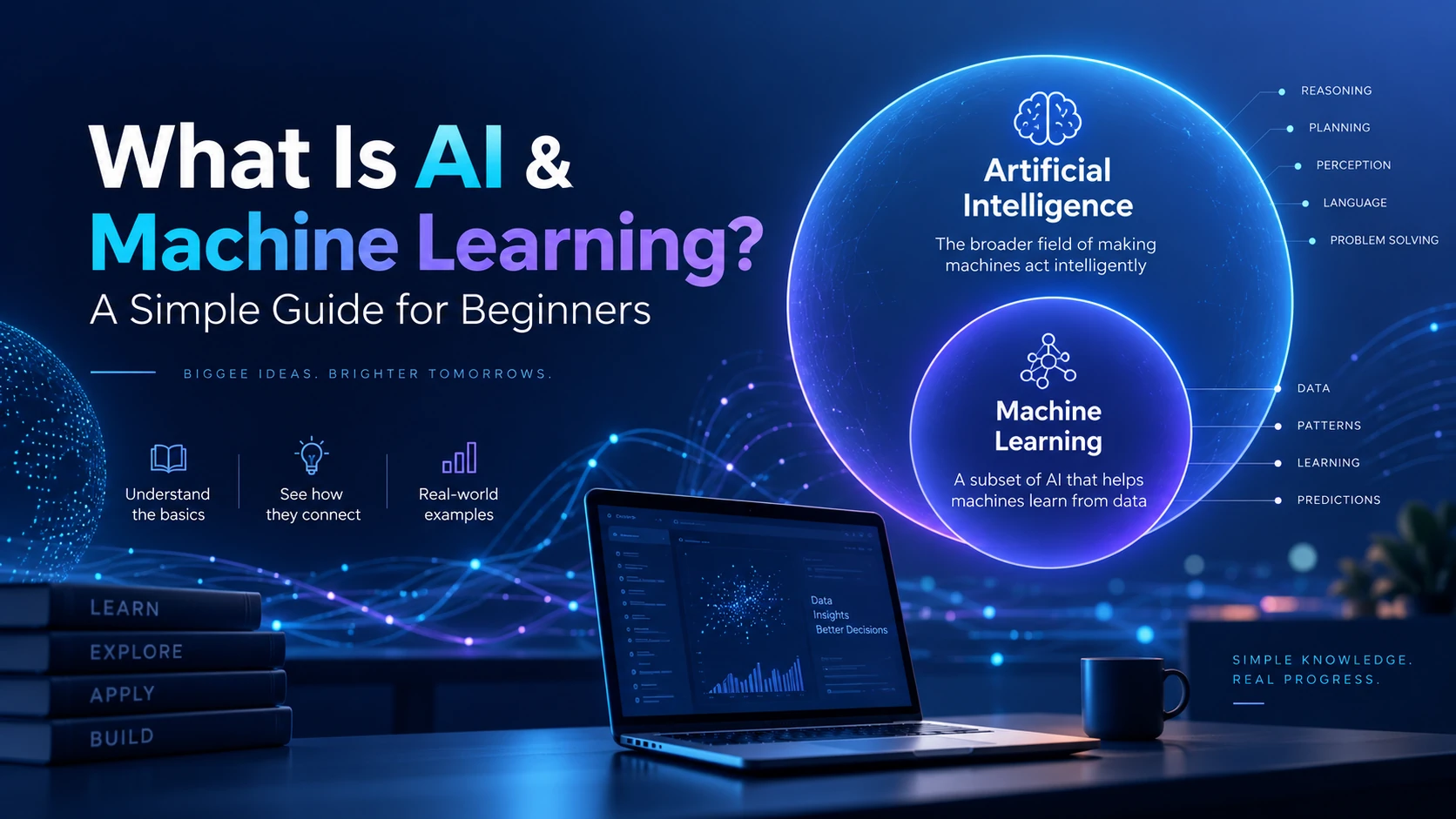
Table of Content
Artificial Intelligence and Machine Learning are two terms that appear almost everywhere today. You hear about AI in smartphones, websites, search engines, cars, hospitals, banks, education platforms, social media, and even everyday apps.
But if you are completely new to technology, words such as Artificial Intelligence, Machine Learning, algorithms, neural networks, and training data can sound complicated.
The good news is that the basic idea behind AI and Machine Learning is actually much easier to understand than it first appears.
In simple words, Artificial Intelligence helps computers perform tasks that normally require human intelligence, while Machine Learning helps computers learn patterns from data instead of being programmed for every situation manually.
For example, when your phone recognizes your face, when an email service detects spam, when YouTube recommends a video, or when a shopping website suggests products you may like, some form of AI or Machine Learning may be working in the background.
In this guide, we will understand what AI is, what Machine Learning is, how they work, how they are different, where they are used, and why they matter without making the explanation unnecessarily technical.
What Is Artificial Intelligence?
Artificial Intelligence, commonly called AI, is a field of technology that focuses on making computers and machines capable of performing tasks that usually require human intelligence.
These tasks can include:
- Understanding language
- Recognizing images
- Answering questions
- Making recommendations
- Identifying patterns
- Solving problems
- Planning actions
- Detecting unusual activity
- Generating text or images
- Making predictions
Think about a traditional calculator.
A calculator follows fixed mathematical instructions. You enter 5 + 5, and it calculates the answer according to predefined rules.
AI systems can be more flexible.
For example, an AI-powered assistant may understand a sentence written in natural language, identify what the user wants, process relevant information, and produce an appropriate response.
This does not necessarily mean the computer understands the world exactly as a human does. It means the software has been designed or trained to perform tasks that appear intelligent.
What Is Machine Learning?
Machine Learning, often called ML, is a part of Artificial Intelligence that allows computers to learn patterns from data.
Instead of programming every possible situation manually, developers give the Machine Learning system examples or data.
The system studies that data and tries to discover useful patterns.
Imagine that you want to create software that identifies pictures of cats.
One traditional approach would be to manually write many rules such as:
- A cat usually has two ears.
- A cat may have whiskers.
- A cat has four legs.
- A cat may have a tail.
- Its face has certain shapes.
The problem is that animals can appear in thousands of different positions, colors, lighting conditions, and backgrounds.
Writing rules for every possible image would be extremely difficult.
Machine Learning uses a different approach.
You can provide the system with many labeled examples of cat and non-cat images. A Machine Learning model analyzes those examples and learns patterns that help it distinguish cats from other objects.
Later, when it receives a new image, it can estimate whether the image contains a cat.
That process is one of the core ideas behind Machine Learning.
AI and Machine Learning With a Simple Example
Consider an email inbox.
Every day, millions of emails are sent around the world. Some are useful messages, while others are spam.
Imagine trying to manually write rules for every spam email.
You might create rules such as:
- If the subject contains certain suspicious words, mark it as spam.
- If the sender is unknown, check it carefully.
- If the email contains too many links, consider it suspicious.
But spammers constantly change their messages.
A Machine Learning-based system can study large numbers of emails that have already been identified as spam or legitimate.
From those examples, it can learn patterns such as:
- Common spam phrases
- Suspicious sender behavior
- Unusual link patterns
- Message structure
- Frequency of certain terms
- Previous user actions
When a new email arrives, the system analyzes these patterns and predicts whether the message is likely to be spam.
Here, Artificial Intelligence is the broader goal of making the system intelligently identify unwanted emails, while Machine Learning is one method used to help the system learn how to do it.
How Does Artificial Intelligence Work?
There is no single method used by every AI system.
Artificial Intelligence is a large field containing many different technologies and techniques.
A basic AI system may include several important parts.
1. Data
Many modern AI systems require data.
Data can include:
- Text
- Images
- Videos
- Audio
- Numbers
- Customer activity
- Sensor readings
- Website interactions
The quality of the data often affects the quality of the system.
If the data is inaccurate, incomplete, outdated, or strongly biased, the AI system may produce poor results.
2. Algorithms
An algorithm is a set of instructions or procedures used to solve a problem.
AI algorithms help computers process information and identify useful patterns.
Different problems require different types of algorithms.
An algorithm used for image recognition may be different from one used for detecting financial fraud.
3. Models
A model is the result of a system learning patterns from data.
After training, the model can be used to make predictions, classifications, recommendations, or other outputs.
For example, a model may predict:
- Whether a transaction looks fraudulent
- Which movie a user may enjoy
- Whether an image contains a dog
- Whether a customer may cancel a subscription
4. Input
The AI system receives information.
For example, the input could be:
- A question
- A photograph
- A voice recording
- A customer transaction
- A medical image
5. Processing
The system analyzes the input using its algorithms and learned patterns.
6. Output
Finally, the AI provides an output.
This might be:
- A prediction
- A recommended product
- An answer
- A classification
- A generated image
- A warning
- A translation
The exact process depends on how the AI system was designed.
How Does Machine Learning Work?
Machine Learning generally involves several stages.
Step 1: Collect Data
The first step is collecting useful data related to the problem.
Suppose a company wants to build a model that predicts house prices.
The data might contain:
- House size
- Location
- Number of rooms
- Property age
- Previous selling prices
Step 2: Prepare the Data
Real-world data is often messy.
It may contain:
- Missing values
- Duplicate records
- Incorrect information
- Different formats
Developers or data professionals usually clean and prepare the data before training a model.
Step 3: Choose a Machine Learning Algorithm
Different algorithms are suitable for different problems.
Some algorithms are used for prediction, while others are better for classification or grouping.
Step 4: Train the Model
During training, the algorithm analyzes examples in the dataset.
The model adjusts itself to identify patterns that connect the available information with the expected result.
In the house-price example, the model may learn that location, property size, and number of rooms strongly influence price.
Step 5: Test the Model
The model should then be tested using data it did not simply memorize during training.
Testing helps developers understand whether the model performs well on new information.
Step 6: Use the Model
Once the model performs well enough for its intended purpose, it can be used in an application.
For example, a real estate website could allow users to enter property information and receive an estimated price.
Step 7: Improve Over Time
Depending on the system, developers may collect additional data, evaluate mistakes, retrain the model, and improve its performance.
Machine Learning development is often an ongoing process rather than something completed once forever.
AI vs Machine Learning
AI and Machine Learning are related, but they are not exactly the same thing.
The easiest way to understand the relationship is this:
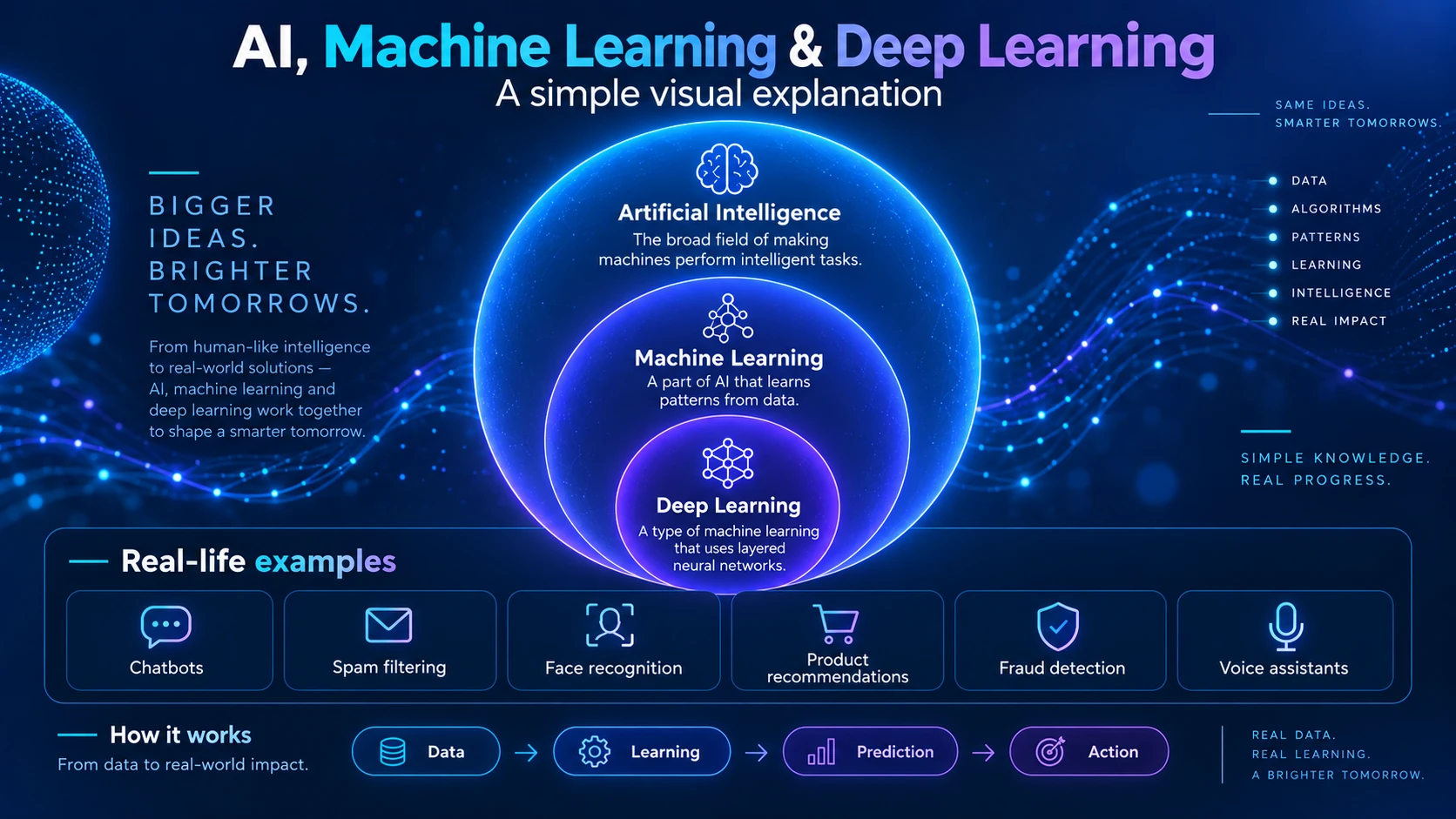
Artificial Intelligence is the bigger concept. Machine Learning is one approach used to create AI systems.
Imagine Artificial Intelligence as a large umbrella.
Under that umbrella, you can find technologies such as:
- Machine Learning
- Deep Learning
- Natural Language Processing
- Computer Vision
- Robotics
- Expert Systems
- Planning systems
Machine Learning focuses specifically on helping systems learn useful patterns from data.
Therefore:
AI = The broader goal of creating intelligent computer systems
Machine Learning = A method that helps computers learn from data
Not every AI application must use Machine Learning, although Machine Learning is extremely important in modern AI.
Types of Artificial Intelligence
AI can be described in different ways, but beginners commonly hear about Narrow AI, General AI, and Superintelligence.
Narrow AI
Narrow AI is designed for specific tasks.
Examples can include systems designed for:
- Recommendation
- Image classification
- Translation
- Fraud detection
- Voice recognition
- Search ranking
A system may perform one particular task extremely well without having broad human-like intelligence.
Most AI systems used today fall into this general category.
Artificial General Intelligence
Artificial General Intelligence, commonly called AGI, usually refers to a hypothetical AI system that could perform a broad range of intellectual tasks with flexibility comparable to humans.
Researchers and companies continue to explore increasingly capable AI systems, but the meaning, requirements, and measurement of AGI are still debated.
Artificial Superintelligence
Artificial Superintelligence is a theoretical concept describing intelligence that significantly exceeds human abilities across many areas.
It is frequently discussed in research, philosophy, technology forecasting, and science fiction, but it should not be confused with ordinary AI applications currently used by businesses and consumers.
Types of Machine Learning
Machine Learning is commonly divided into several major approaches.
1. Supervised Learning
In supervised learning, a model learns from labeled examples.
For example, imagine a dataset containing thousands of emails already labeled as:
- Spam
- Not spam
The model studies those examples and learns how to classify new emails.
Supervised learning can be used for tasks such as:
- Price prediction
- Fraud detection
- Image classification
- Customer churn prediction
2. Unsupervised Learning
In unsupervised learning, data does not necessarily include predefined labels.
The system attempts to discover hidden patterns or groups.
For example, an online store may analyze customer behavior and discover different customer groups based on their shopping habits.
Businesses can use these patterns to better understand their audience.
3. Reinforcement Learning
Reinforcement Learning involves an agent learning through actions and feedback.
The system tries different actions and receives rewards or penalties depending on the results.
Over time, it learns strategies that produce better rewards.
Reinforcement Learning can be useful in areas such as:
- Robotics
- Game-playing systems
- Resource optimization
- Certain control systems
Everyday Examples of AI and Machine Learning
You may already use AI-powered technology every day without consciously thinking about it.
Search Engines
Search engines use sophisticated systems to understand queries and rank useful results.
If you type a question instead of an exact keyword, modern search systems can often understand the general meaning of your request.
Recommendation Systems
Platforms may recommend:
- Videos
- Music
- Products
- Posts
- Movies
- Articles
These recommendations can be influenced by your previous activity and patterns seen across many users.
Smartphone Cameras
Modern smartphone cameras can use AI-based processing for tasks such as:
- Scene recognition
- Portrait effects
- Image enhancement
- Low-light improvement
- Face detection
Voice Assistants
Voice-based systems can process spoken language and convert it into useful actions.
For example, they may:
- Set alarms
- Search information
- Play music
- Create reminders
- Control connected devices
Navigation Apps
Navigation applications can analyze road information, traffic patterns, and other data to estimate travel time and suggest routes.
Online Shopping
E-commerce websites may use AI and Machine Learning for:
- Product recommendations
- Search ranking
- Fraud prevention
- Customer support
- Demand forecasting
Social Media
Social platforms may use Machine Learning to decide which content appears in a feed, identify spam, recommend accounts, or improve moderation systems.
Banking
Banks and financial services companies can use Machine Learning to detect unusual transaction patterns.
For example, if a card suddenly shows activity very different from a customer's normal behavior, automated systems may flag the transaction for further review.
Advantages of AI and Machine Learning
AI and Machine Learning can provide significant benefits when they are designed and used responsibly.
Automation of Repetitive Tasks
Computers can perform certain repetitive tasks faster than humans.
This allows employees to spend more time on work requiring creativity, judgment, communication, or decision-making.
Processing Large Amounts of Data
Humans cannot manually analyze millions of records quickly.
Machine Learning systems can process large datasets and identify patterns that would be difficult to discover manually.
Personalization
AI can help create more personalized experiences.
Examples include:
- Product recommendations
- Personalized learning content
- Music recommendations
- Customized search results
Faster Decision Support
AI tools can help professionals analyze information more quickly.
The final decision may still require human judgment, especially in important areas such as medicine, finance, hiring, and law.
Improved Detection
Machine Learning can help detect patterns associated with:
- Fraud
- Spam
- Cybersecurity threats
- Manufacturing defects
- Equipment failure
These systems do not eliminate the need for human expertise, but they can provide valuable assistance.
Limitations and Challenges of AI and Machine Learning
AI is powerful, but it is not perfect.
Understanding its limitations is just as important as understanding its benefits.
AI Can Make Mistakes
AI outputs should not automatically be treated as correct.
A system can make incorrect predictions or generate inaccurate information.
For important decisions, human verification may still be necessary.
Bias in Data
AI systems learn from data.
If training data contains unfair patterns or does not represent different groups properly, the system may produce biased results.
Developers must therefore evaluate datasets and models carefully.
Privacy Concerns
Many AI applications process user data.
Organizations must handle personal information responsibly and comply with applicable privacy and data-protection requirements.
Security Risks
AI systems can also become targets for cyberattacks.
Attackers may attempt to manipulate data, exploit weaknesses, steal information, or misuse AI-powered tools.
Security should therefore be considered throughout system development.
Cost
Advanced AI systems can require:
- Powerful computing hardware
- Large datasets
- Skilled professionals
- Cloud resources
- Significant electricity
This can make sophisticated AI development expensive.
Lack of Context
AI may recognize patterns without understanding situations exactly as humans do.
A model may produce technically plausible results that are incorrect because it lacks important context.
That is why responsible human oversight remains important.
AI and Machine Learning in Different Industries
AI is no longer limited to technology companies.
Organizations across many industries are exploring AI applications.
Healthcare
AI can assist with tasks such as:
- Medical image analysis
- Administrative automation
- Patient scheduling
- Research data analysis
- Clinical decision support
However, medical decisions require appropriate professional oversight, validation, and regulatory compliance.
Education
AI can support students and teachers through:
- Personalized learning
- Automated practice exercises
- Language assistance
- Learning analytics
- Content recommendations
The role of teachers remains important because education involves mentorship, motivation, context, communication, and human understanding.
Cybersecurity
Machine Learning can help cybersecurity teams analyze large amounts of activity and identify unusual patterns.
Potential applications include:
- Spam filtering
- Phishing detection
- Malware analysis
- Network anomaly detection
- Fraud monitoring
Cybersecurity professionals still need to verify alerts because automated systems may produce false positives or miss sophisticated attacks.
Finance
Financial organizations may use AI for:
- Fraud detection
- Customer support
- Risk analysis
- Document processing
- Market research
High-impact financial decisions should not rely blindly on automated outputs.
Manufacturing
AI can be used for:
- Predictive maintenance
- Quality inspection
- Production optimization
- Robotics
- Supply chain planning
For example, sensor data from machines may help predict when equipment needs maintenance.
Agriculture
AI can support agriculture through:
- Crop monitoring
- Weather analysis
- Pest detection
- Soil analysis
- Smart irrigation
These technologies can help farmers use available resources more effectively.
Do AI Systems Really Think Like Humans?
This is one of the most common questions beginners ask.
AI systems can produce outputs that appear intelligent, but that does not mean their internal process is identical to human thought.
Humans combine many things when making decisions, including:
- Memory
- Emotion
- Personal experience
- Common sense
- Social understanding
- Physical experience
- Cultural knowledge
AI systems operate using computational processes, data, algorithms, learned parameters, and programmed instructions.
Some modern systems can produce remarkably human-like text, images, audio, or decisions, but it is important not to automatically assume that a convincing response means the system experiences understanding exactly like a person.
What Is Deep Learning?
Deep Learning is a specialized area within Machine Learning.
It uses structures called neural networks, particularly networks with many layers.
The term "neural network" was inspired partly by biological neurons, although artificial neural networks are mathematical systems and should not be treated as exact replicas of the human brain.
Deep Learning has played an important role in areas such as:
- Computer vision
- Speech recognition
- Natural language processing
- Generative AI
- Autonomous systems
Deep Learning often benefits from large amounts of data and powerful computing resources.
A simple relationship to remember is:
Artificial Intelligence → Machine Learning → Deep Learning
AI is the broadest field.
Machine Learning is part of AI.
Deep Learning is part of Machine Learning.
What Is Generative AI?
Generative AI refers to AI systems designed to generate new content.
Depending on the model, this content may include:
- Text
- Images
- Audio
- Video
- Code
- Music
- Designs
Traditional Machine Learning applications are often associated with prediction or classification.
For example, a model may predict whether a transaction is fraudulent.
Generative AI can create an output based on patterns learned during training.
For example, a generative AI system might create a paragraph from a prompt.
Generative AI has become popular because people can interact with advanced systems using everyday language rather than complex programming commands.
However, generated content still needs verification because AI can produce inaccurate or misleading information.
Will AI Replace Humans?
The question "Will AI replace humans?" is more complicated than a simple yes or no.
Some tasks will certainly become more automated.
Jobs containing large amounts of repetitive digital work may change significantly.
At the same time, new technologies usually create new responsibilities, tools, specialties, and industries.
Instead of assuming that every job will disappear, it is more useful to think about how AI will change the way different jobs are performed.
For example, a software developer may use AI to:
- Explain code
- Generate test cases
- Find bugs
- Create documentation
- Explore solutions
But developers still need to understand requirements, architecture, security, performance, and real business problems.
Similarly, marketers may use AI to generate ideas but still need creativity, brand knowledge, strategy, and audience understanding.
The people who learn how to work effectively with AI may be better prepared for workplaces where AI tools become common.
Skills Needed to Learn AI and Machine Learning
You do not need to become an expert immediately.
Beginners can learn AI step by step.
A useful learning path may include the following.
Basic Computer Knowledge
Understand:
- Files and folders
- Applications
- Operating systems
- Basic internet concepts
Programming
Python is widely used for Machine Learning because it has a large ecosystem of libraries and learning resources.
Important beginner programming topics include:
- Variables
- Conditions
- Loops
- Functions
- Lists
- Dictionaries
- Object-oriented programming basics
Mathematics
For beginner-level understanding, you can start with:
- Basic algebra
- Statistics
- Probability
- Graphs
Advanced AI study may later involve linear algebra, calculus, optimization, and more advanced statistics.
Data Handling
Learn how to:
- Read datasets
- Clean data
- Find missing values
- Analyze patterns
- Visualize information
Machine Learning Fundamentals
Once comfortable with programming and data, study topics such as:
- Regression
- Classification
- Clustering
- Model training
- Model testing
- Overfitting
- Evaluation metrics
Practical Projects
Projects are one of the best ways to understand Machine Learning.
Beginner project ideas include:
- Spam email classifier
- House price predictor
- Student performance predictor
- Movie recommendation system
- Simple image classifier
You do not have to build an extremely complicated AI application for your first project.
A small working project can teach you more than reading dozens of theoretical definitions without practice.
Why Data Is Important in Machine Learning
Data is one of the most important parts of Machine Learning.
Imagine teaching someone to recognize different fruits.
If you show that person only red apples, they may become confused when they see a green apple.
The same problem can happen in Machine Learning.
If the training dataset does not contain enough variety, the model may struggle with real-world situations.
Good datasets should ideally be:
- Relevant
- Accurate
- Sufficiently representative
- Properly prepared
- Appropriate for the intended use
More data does not automatically guarantee a better model.
The quality, relevance, and diversity of the data are also important.
Training Data vs Testing Data
Beginners often hear the words training data and testing data.
They serve different purposes.
Training data is used to teach the model.
Testing data helps evaluate how well the model performs on information it has not simply memorized.
Imagine a student who studies only ten exact questions before an exam.
If the exam contains exactly those questions, the student may score well without truly understanding the topic.
A better test contains new questions based on the same concepts.
Machine Learning evaluation works in a somewhat similar way.
A useful model should perform well on new examples, not only the examples used during training.
What Is an AI Model?
An AI model is a computational system that has been trained or configured to perform certain tasks.
You can think of a trained model as a set of learned patterns.
For example, an image classification model may learn patterns that help distinguish cars, dogs, birds, and other objects.
When a new image is provided, the model processes it and produces a prediction.
Models can vary enormously in complexity.
Some models may be relatively small and designed for one narrow purpose.
Others may contain extremely large numbers of parameters and perform many different tasks.
Why AI and Machine Learning Matter
AI and Machine Learning matter because the amount of digital information generated by modern society is enormous.
Businesses and individuals generate data through:
- Websites
- Smartphones
- Sensors
- Financial transactions
- Social networks
- Business software
- Cameras
- Medical devices
- Connected machines
It is impossible for humans to manually analyze all of this information.
Machine Learning can help identify patterns in large datasets, while Artificial Intelligence can help turn those patterns into useful tools and automated systems.
When used carefully, AI can improve efficiency, accessibility, personalization, research, and decision support.
However, powerful technology must also be used responsibly.
Accuracy, security, privacy, fairness, and human oversight should remain important considerations.
The Future of AI and Machine Learning
AI and Machine Learning are likely to remain important parts of modern technology.
Future improvements may continue in areas such as:
- AI assistants
- Robotics
- Healthcare tools
- Education technology
- Cybersecurity
- Software development
- Scientific research
- Business automation
- Smart devices
- Accessibility tools
At the same time, governments, researchers, businesses, and the public will continue discussing important questions related to:
- Privacy
- Copyright
- Safety
- Security
- Employment
- Bias
- Regulation
- Transparency
- Responsible AI development
Learning basic AI concepts today can therefore be valuable even if you do not plan to become an AI engineer.
AI literacy is increasingly useful for students, developers, business professionals, creators, researchers, and everyday internet users.
Final Thoughts
Artificial Intelligence and Machine Learning may sound complicated, but their basic ideas are straightforward.
Artificial Intelligence is the broader idea of building computer systems capable of performing tasks that normally require human intelligence.
Machine Learning is a part of AI that allows computers to learn patterns from data and use those patterns to make predictions or decisions.
A simple way to remember the difference is:
AI is the goal. Machine Learning is one of the methods used to achieve that goal.
AI already influences many technologies we use every day, from search engines and recommendation systems to fraud detection and smartphone cameras.
At the same time, AI should not be viewed as magic.
AI systems depend on data, algorithms, computing resources, human design decisions, and careful evaluation. They can be extremely useful, but they can also make mistakes.
For students and beginners, the best approach is to start with the fundamentals.
Learn basic programming, understand how data works, explore Machine Learning concepts, and gradually build small projects.
You do not need to understand every advanced mathematical formula on your first day.
Start with one simple idea:
AI helps machines perform intelligent tasks, and Machine Learning helps machines learn useful patterns from data.
Once you understand that relationship, the rest of the AI world becomes much easier to explore.
Frequently Asked Questions
1. What is AI in very simple words?
Artificial Intelligence is technology that allows computers or machines to perform tasks that normally require human intelligence. These tasks can include understanding language, recognizing images, recommending products, detecting unusual activity, and answering questions.
2. What is Machine Learning in simple words?
Machine Learning is a part of AI that helps computers learn patterns from examples or data. Instead of manually programming every possible situation, developers train a Machine Learning model using data so that it can make predictions or classifications when it receives new information.
3. What is the main difference between AI and Machine Learning?
Artificial Intelligence is the broader concept of creating intelligent computer systems. Machine Learning is one technique used to build those systems. In simple terms, AI is the larger field, while Machine Learning is a part of AI.
4. What are some examples of AI and Machine Learning in daily life?
Common examples include spam email detection, product recommendations, smartphone face recognition, navigation apps, search engines, voice assistants, fraud detection systems, social media recommendations, and automated customer-support tools.
5. Is AI difficult to learn for beginners?
AI can become technically advanced, but beginners can start with simple concepts. Learning basic Python, mathematics, statistics, data handling, and introductory Machine Learning concepts provides a good foundation. Building small practical projects can make the learning process easier and more understandable.